
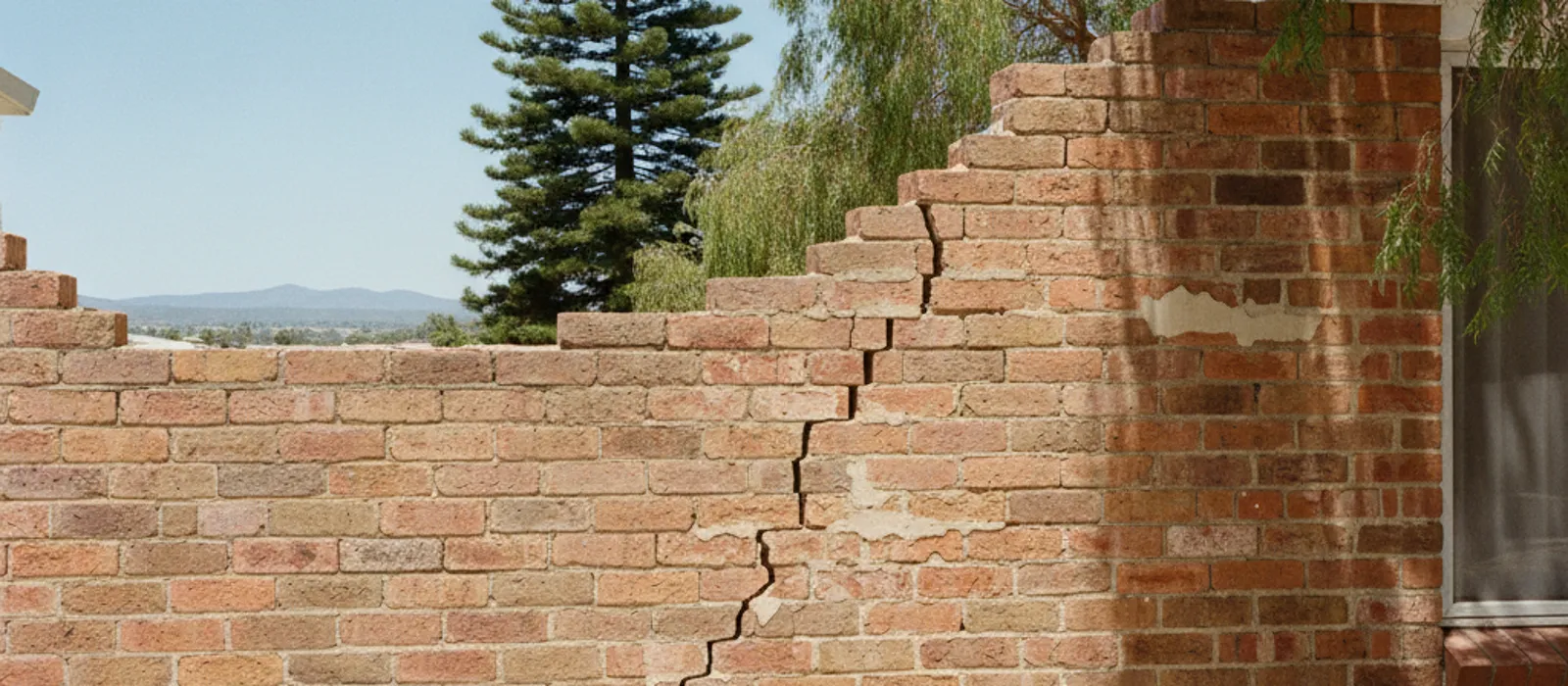
You notice it while hanging washing: a zigzag line through the mortar under the laundry window, wide enough to slide a fingernail into. Last summer it wasn’t there. Or maybe it was, and you just never looked.
Cracks in brick walls are common in Perth. Most of our houses are brick, and brick shows movement readily. A Housing Industry Association report, cited by the ABC in June 2026, found WA was the only state where more than half of detached houses were built of brick, at 68 per cent. So when a crack appears, the questions are always the same. What is it telling you, how worried should you be, and who can give you a straight answer?
This guide walks through the main crack patterns, the crack widths engineers use to grade damage, and the point where a photo on your phone stops being enough. It won’t tell you your crack is harmless. Nobody can do that honestly from a web page.
Why cracks in brick walls show up in Perth homes
Brick is strong under load and poor at bending. When the ground under a footing moves, even a little, the wall has nowhere to go and the mortar joints give first.
CSIRO’s homeowner guide to foundation maintenance (the 2024 edition of Building Technology File 18) lists the usual culprits, and several of them fit Perth closely:
- Water washing out sand. CSIRO notes that sandy soil is particularly prone to being washed away. A leaking pipe, a broken stormwater line or a downpipe that dumps roof water beside the wall can scour sand from under a footing.
- Leaks near the house. A leaking water, sewer or stormwater pipe can erode, swell or saturate the ground. On clay, CSIRO says even a tiny leak can be enough.
- Garden watering. Reticulation that runs too long, or sprays straight onto the base of a wall, is a common cause of wet foundations.
- Trees. Roots can lift footings, or dry out clay and make it shrink.
- Clay moving with the seasons. Reactive clay swells when wet and shrinks when dry. Doors bind, cornices crack, and brickwork follows.
Geology matters here. Geoscience Australia describes much of central Perth as sitting on Bassendean Sand, and the coastal strip on Tamala Limestone and dune sands. The Guildford Formation, a silty clay, outcrops over much of the eastern suburbs, and the Perth Hills have clay sites too. Down in Peel, the Pinjarra Plain is mostly clayey alluvium. That’s a regional picture only. Your block’s actual soil is a matter for a soil test or an engineer, not a suburb name.
For a longer look at the causes, see why Perth houses crack.
Reading the pattern: stepped, vertical, horizontal and around windows
The shape of a crack is a clue to what moved. It’s a clue, not a diagnosis. CSIRO makes the point that symptoms often don’t simply reflect the original cause, which is why engineers look at the whole house, not one crack.
Stepped cracks in the mortar
A stepped crack climbs diagonally through the mortar joints, like a staircase. CSIRO lists step cracking in mortar as one of the ways foundation erosion shows up in masonry. It often means one part of the wall has dropped or lifted relative to the rest.
Things worth noting before anyone visits:
- Which way does the “staircase” lean? It often points towards the part of the wall that moved.
- Is it wider at the top or the bottom?
- Has it cracked through bricks as well as mortar?
- Is there a downpipe, tap, soakwell, garden bed or tree nearby?
Vertical cracks
A vertical crack runs more or less straight up. At a window or door, CSIRO links vertical cracking at openings with foundation movement. A vertical crack near a corner, or one that’s wider at the top than the bottom, suggests the ends of the wall are moving differently from the middle.
Long runs of brickwork also move with temperature and moisture. Some vertical cracks are the wall finding its own movement joint. Telling that apart from footing movement needs someone on site.
Cracks above windows and doors
A crack that starts at the corner of a window head and runs up or sideways often gets blamed on the lintel, the steel angle that carries the brickwork over the opening. A WA building-inspection firm has called coastal WA “the perfect rust storm” for steel lintels: the steel rusts, the rust expands, and the brick and mortar around it crack. That’s a secondary source, not a standard, but the pattern is well known.
Signs that point towards a lintel: rust staining, a lifted or bowed row of bricks directly over the opening, or cracking at both ends of the window head. More on that in rusted lintels in Perth homes.
Horizontal cracks
A horizontal crack along a mortar course is less common and deserves attention, especially if the wall looks out of line when you sight along it. CSIRO’s most severe damage category includes walls that lean or bulge. Don’t lean a ladder on it, and don’t wait on it.
If you have a crack that fits any of these descriptions, the practical next step is simple. Send us a note and a few photos through the enquiry form and we’ll put you in touch with an independent structural engineer, who quotes you in writing and contracts with you directly. Prefer to talk? Call (08) 5550 6237.
How wide is too wide? Grading cracks in brick walls
Engineers don’t grade cracks by how alarming they look. They measure them. CSIRO reproduces the damage categories from AS 2870-2011 (Table C1), and they give you a shared language with whoever assesses the house.
| Category | Approx. crack width | What it typically looks like |
|---|---|---|
| 0 Negligible | under 0.1 mm | Hairline cracks |
| 1 Very slight | under 1 mm | Fine cracks that don’t need repair |
| 2 Slight | under 5 mm | Noticeable but easily filled; doors and windows stick slightly |
| 3 Moderate | 5 to 15 mm, or several cracks of 3 mm or more in one group | Some wall replacement possible; doors and windows stick; pipes can fracture |
| 4 Severe | 15 to 25 mm, also depends on the number of cracks | Extensive repair; frames distort; walls lean or bulge |
A few things the table doesn’t tell you:
- Width isn’t everything. Several 3 mm cracks grouped together already reach category 3. A crack that’s growing matters more than one that’s been stable for years.
- Stickiness counts. Doors that suddenly bind, or windows that won’t latch, are part of the picture.
- Category 4 is the top. The current CSIRO table stops there.
CSIRO also says most cracking in masonry walls is a cosmetic nuisance. That’s a statement about cracks in general, not about yours. The same guide says monitoring should always be taken seriously, which is the better half of the advice.
How to monitor at home. Photograph the crack with a ruler or tape measure held beside it, and date the photo. Mark each end of the crack lightly in pencil with the date. Check it again after a few weeks and after a change of season. A cheap crack-width card from a hardware store makes readings more consistent. None of this replaces an assessment, but it gives the engineer a history instead of a guess.
Three Perth cases, anonymised
These are composite examples to show how cracks get read. The dollar figures come from published WA government charges and published Perth inspection prices, not from any engineer’s invoice.
A stepped crack above a window, two streets from the beach in Rockingham
The owners of a brick-and-tile house found a crack stepping up from the corner of a bedroom window head, with a thin brown stain along the brick course above it. Their pre-purchase report from a few years earlier had been a building inspection, not an engineer’s report. In Perth those typically start from around $440 incl. GST.
The questions for an engineer were narrow. Was this the lintel rusting and jacking up the brickwork, footing movement showing at the weakest point in the wall, or both? The answer decides who does what next: an engineer’s advice on the lintel detail, then a builder for the work. Crack width alone, about 2 mm here, wouldn’t have settled it.
A Kalamunda home on clay, back doors sticking after a wet winter
In the Perth Hills near Kalamunda, a 1980s brick house on a clay block had rear sliding doors that started dragging in August. Stepped cracks opened either side of the doors, three of them in a group, each around 3 mm. On the CSIRO scale, that grouping already sits at category 3.
Downpipes on that side emptied onto the ground rather than into stormwater, which CSIRO identifies as a way to concentrate water beside footings. The engineer’s job was to work out whether this was seasonal clay movement that might partly close up in summer, or something more. If the answer turns out to be footing work, that is not exempt from a building permit in WA. A certified building permit costs 0.19 per cent of the estimated value of the work, not less than $121.00, plus a Building Services Levy of $61.65 where the work is $45,000 or less.
A 1970s double-brick house in the northern suburbs with a new soakwell
After a new soakwell went in beside the garage of a double-brick home on a sandy block, a vertical crack appeared at the garage corner, wider at the top. In double-brick houses the inner leaf of the external walls usually carries floors, ceilings and roof, so a crack through both leaves is a bigger question than one through the outer skin.
The City of Joondalup requires soakwells to sit at least the width of the soakwell away from buildings and boundaries (where the width is greater than or equal to the depth), so digging the hole doesn’t undermine footings. This one was closer than that. The engineer needed to check whether the excavation had disturbed the sand under the footing and what the wall needed. Other councils may set different rules, so check yours.
Building inspector or structural engineer: who should look at it?
This is where a lot of Perth owners spend money twice.
Many “structural inspections” advertised in Perth are pre-purchase building inspections to AS 4349.1, carried out by building inspectors. They’re useful when you’re buying. Published Perth prices run from around $440 incl. GST, with some around $495 to $550. But at least one Perth inspection firm says outright that it doesn’t provide structural design, engineering drawings or engineering certification. A building inspector can tell you a crack exists and flag it. When the question is why the wall moved and what it needs, that’s an engineer’s job. See structural inspection vs building inspection for the long version.
What an engineer’s report usually covers: the foundation, walls and roof structure, floors and ceilings, the slab and footings, and signs of cracking, sagging or shifting. It should record what was seen, what the engineer thinks is causing it, and what should happen next.
What does it cost? No Perth engineering firm we could find publishes a fixed fee for a crack report. Engineers quote each job. The price depends on the house, how much of it needs looking at, and whether the owner needs a letter, a full report or design work. Our structural engineer cost guide for Perth sets out the figures that do exist and what each one actually buys.
Interstate / national figures, not Perth prices. A national marketplace survey (Bark, updated March 2026, drawn from about 370 jobs Australia-wide) reported an average of $560 excluding GST for a residential inspection and report. It gave no Perth figure. Use it as background only.
Checking the engineer. Registration of structural building engineers in WA began on 1 July 2024. From 1 July 2027, structural engineering work must be done by a registered building engineer. Building and Energy (DEMIRS) keeps a Building Engineer Register, and the WA Government’s building engineering registration page explains how it works. It’s worth a two-minute check before you book anyone.
Where we fit. Kings Park Structural Co is a referral service, not an engineering firm. We pass your enquiry to an independent structural engineer, who quotes you and contracts with you directly. The engineer assesses the crack. If work is needed, a registered builder does it. Our structural inspections page explains what to have ready.
Worried about a crack right now? Tell us what you’ve found on the enquiry form, with photos and the widths you’ve measured, and ask for a written quote from an independent structural engineer. Or ring (08) 5550 6237.
For the full CSIRO guidance, the Foundation Maintenance and Footing Performance guide (PDF) is free and readable.
Frequently Asked Questions
Are stepped cracks in brick walls serious?
It depends on the width, whether the crack is growing, and what else is happening in the house. Under the CSIRO categories, a stepped crack under 1 mm is very slight, while several cracks of 3 mm or more in one group reach category 3. Sticking doors or cracks through the bricks themselves add weight. Only someone who has seen the house can tell you whether yours matters.
How much does a structural engineer’s crack report cost in Perth?
No Perth engineering firm we found publishes a fixed price. Engineers quote each job, and the price depends on the house, the extent of the problem and the kind of report you need. The Perth prices you’ll see advertised, from around $440 incl. GST, are mostly for pre-purchase building inspections, which are a different product.
Is a building inspection the same as a structural engineer’s report?
No. A pre-purchase building inspection to AS 4349.1 is usually done by a building inspector and records visible defects. A structural engineer’s report looks at why the structure moved and what it needs. Some Perth inspection firms state that they don’t provide engineering design or certification.
Will my home insurance pay for cracks in brick walls?
Check your own policy. Many home policies exclude gradual subsidence and ground movement, and some exclude damage from leaks the owner should have known about. An engineer’s report can help you understand the cause, but it can’t tell you what your insurer will decide.