
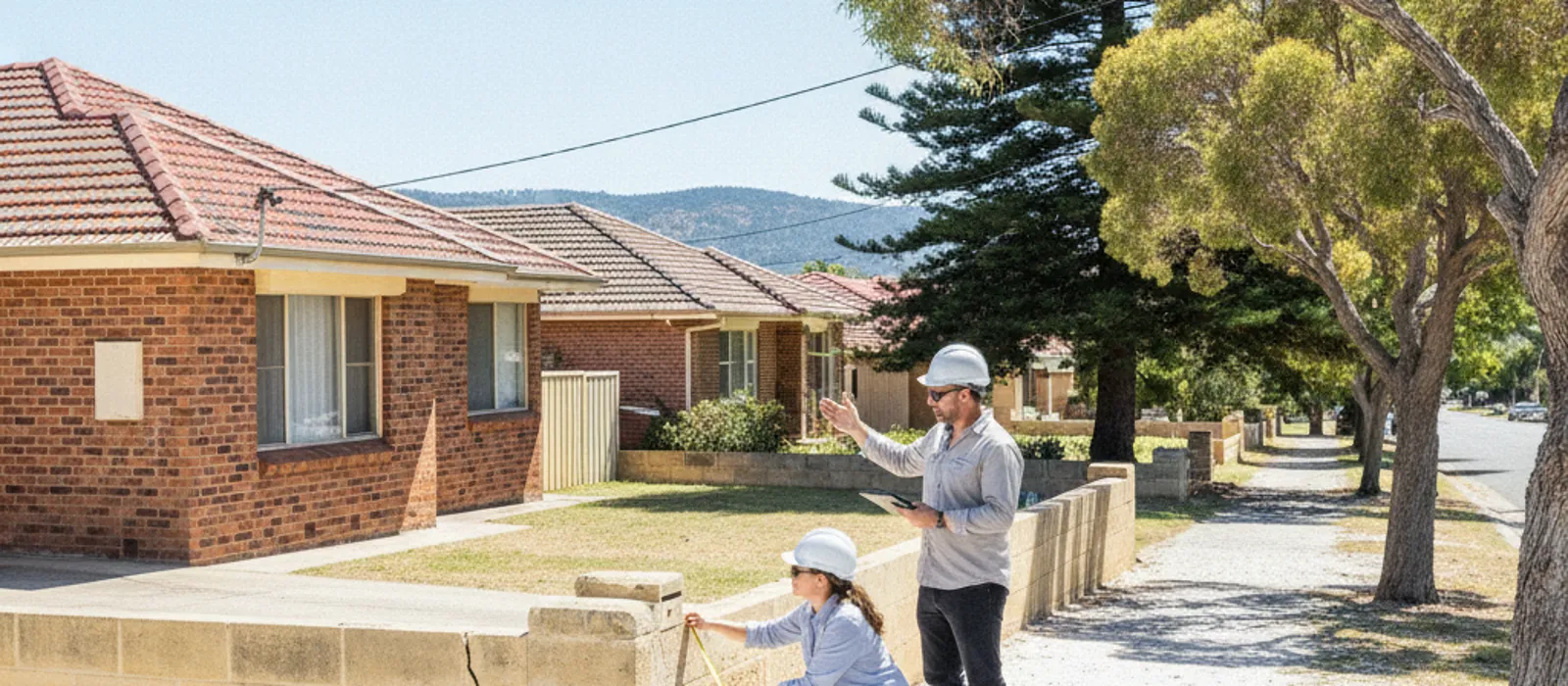
The back door stuck a little after the wet winter, and now there’s a diagonal line running out from the corner of the lounge room window. You’ve got two questions: is the house moving, and is it going to cost a fortune? The honest answer to the first is “probably a little, as every house does”. The second depends on what is moving and why, and that starts with the ground.
Perth houses crack for a handful of repeat reasons: reactive soil that swells and shrinks, sand that gets washed away, water in the wrong place, and trees drinking from the wrong spot. This guide explains each one, what the damage looks like, and when a photo on your phone stops being enough.
If you’d rather skip straight to getting a written quote from an independent structural engineer, tell us what needs looking at and we’ll pass it on. The engineer contracts with you directly. We’re a referral service, not the engineering firm.
Perth’s ground: mostly sand, with clay in the east and south
Most of the Perth metropolitan area sits on sand, and that shapes everything else. A Perth geotechnical firm says the most common soil type across the metro area is sand, normally classed as Class A under the housing footing standard AS 2870, with clay sites turning up “particularly in the Perth Hills”.
Geoscience Australia’s geology of the region fills in the picture:
- Bassendean Sand covers much of central Perth: pale quartz sand, up to about 80 metres thick, with a cemented layer called coffee rock near the watertable.
- Tamala Limestone runs along the coastal strip. It’s calcareous dune rock with solution channels and cavities.
- Guildford Formation is a brown silty and slightly sandy clay, up to 35 metres thick, and it outcrops over much of the eastern Perth region. The Swan Valley is its type area.
- Pinjarra Plain, in the Peel area, is mostly clayey alluvium.
That’s a regional map, not a lot-by-lot one. Nobody can tell you the soil under your slab from your suburb name, and we won’t try. A soil test or the engineer’s own assessment settles it for your block. Two houses on the same street can behave quite differently once a leaking pipe or a big tree enters the story.
What reactive soil does to a house
Reactive soil is clay that changes volume with its moisture content. It swells when it’s wet and shrinks when it dries. Sand barely does either, which is why AS 2870 sorts sites into classes by how much the ground is expected to move.
Here’s the classification in plain terms:
| AS 2870 site class | What it means | Characteristic surface movement |
|---|---|---|
| A | Most sand and rock sites, little or no movement from moisture changes | Negligible |
| S | Slightly reactive clay | 0 to 20 mm |
| M | Moderately reactive clay or silt | 20 to 40 mm |
| H1 | Highly reactive clay | 40 to 60 mm |
| H2 | Highly reactive clay, very high movement | 60 to 75 mm |
| E | Extremely reactive | Above 75 mm |
| P | Soft soils, loose sands, landslip, collapsing or eroding soils, or sites that can’t otherwise be classified | Needs individual assessment |
The movement figures come from a secondary calculator page summarising the standard, so treat them as a guide to scale and not a design value. An engineer or soil tester assigns the actual class to your site.
Now picture what a 40 mm swing in the ground surface does. In a wet winter the clay swells and the edges of the slab lift, then in a dry summer the edges drop back. CSIRO calls the result dishing and doming: the house shifts slowly through the seasons, doors bind, cornices crack and brickwork follows. It doesn’t take a single dramatic event, just years of the same slow cycle.
A Perth Hills scenario: sticking doors after a wet winter
Take a hypothetical Perth Hills home where the owners have been told the block has clay in it. After a wet winter the back doors start sticking, and a fine crack opens across the plaster above one door frame. Come summer, the doors free up again and the crack seems to close. That come-and-go pattern is exactly what seasonal clay movement looks like.
It’s still not something to diagnose from the couch. CSIRO’s damage table puts “slight” damage (doors and windows sticking a little, cracks under 5 mm) in category 2, and moves to category 3 once cracks reach 5 to 15 mm and windows and doors stick properly. An engineer looks at where the water is going, what the trees are doing and whether the footings match the site class. The report is quoted per job, and the price depends on the house, the structure and what you need the report to say.
Sand cracks houses too, just differently
Sand doesn’t swell, but it does wash away. CSIRO’s foundation maintenance guide (Building Technology File 18, 2024 edition) says sandy soil is particularly susceptible to being washed away, and in a city built on sand that matters.
Where a footing loses its support you tend to get a different crack from clay’s seasonal pattern. In masonry, CSIRO describes erosion as step cracking through the mortar and vertical cracks at openings. It adds that older masonry has little resistance to this kind of movement.
A northern suburbs scenario: a stepped crack near a soakwell
Picture a 1980s brick-and-tile house in the northern suburbs where a stepped crack has crept up from the corner of the garage wall over a couple of summers. Nothing looks wrong at first glance. Then someone notices the soakwell sits close to that corner and the downpipe splash zone is right beside the footing.
City of Joondalup’s rule is that a soakwell should sit at least its own width away from buildings and boundaries, so the excavation and the concentrated water don’t undermine footings. Other councils’ rules may differ, so check your own. Whether that corner has actually lost support is a question for an engineer on site, because from the outside a stepped crack in the mortar can have more than one cause.
The water you control: pipes, downpipes, taps and trees
Here’s the good news in a slightly annoying package. The biggest movers of soil moisture around a Perth house are often things an owner can fix. CSIRO lists these as common causes:
- Leaking pipes. A water, sewer or stormwater leak near the house can erode, swell or saturate the ground. On clay, CSIRO says even a minuscule leak can be enough to saturate the foundation.
- Downpipes not connected to stormwater. They dump roof water beside the footing, exactly where you don’t want it.
- Overwatering. CSIRO calls misuse of automatic watering systems a common cause of saturation. Reticulation spraying the base of a wall is worth a look.
- Trees. Roots can lift footings, or dry clay out and make it shrink. The closer and thirstier the tree, the more it matters. For more on this, read tree roots and cracking houses.
CSIRO’s listed remedies are mostly plain house-keeping: fix the plumbing, install grated drains, and lay a paved apron at least 900 mm wide around the house with a fall of 1:60 so water runs away from the wall. Those jobs belong to plumbers and builders. We don’t arrange them, and an engineer’s role is to work out what’s moving, not to do the repair.
Coastal salt air adds its own twist. A WA building-inspection firm describes coastal WA as tough on steel lintels, because rust expands and pushes the brickwork and mortar apart, typically above windows and doors. That’s a secondary source, but the pattern is worth knowing if you’re near the water.
Reading the damage: what the CSIRO categories say
CSIRO reproduces the crack categories from AS 2870-2011, and they give owners a common language:
- Category 0, negligible: hairline cracks under 0.1 mm.
- Category 1, very slight: fine cracks under 1 mm that don’t need repair.
- Category 2, slight: cracks under 5 mm, noticeable but easily filled, with doors and windows sticking slightly.
- Category 3, moderate: cracks from 5 to 15 mm, or several cracks of 3 mm or more in one group. Doors and windows stick, and pipes can fracture.
- Category 4, severe: cracks from 15 to 25 mm, depending also on how many there are. Frames distort and walls can lean or bulge.
The same guide notes that most cracking in masonry walls is a cosmetic nuisance only. It also says monitoring should always be treated seriously, and that symptoms often don’t simply reflect the original cause. Both statements are true at once, which is why a measured, dated set of photos is more useful than a guess.
Here’s a habit that helps: photograph each crack beside a ruler, mark the ends with a pencil and date, and look again in a month and after the next big rain. If it changes, that’s data an engineer can use. Cracks in walls: when to worry walks through that in more detail.
When you need an engineer, and when you don’t
Not every crack needs one. Fine cracks that don’t grow, and sticking doors that ease off in summer, often call first for a plumber, a tap adjustment or a look at the trees. The honest first step is finding out whether an engineer is needed at all.
Bring one in when any of these apply:
- Cracks are widening, or you can push a coin into them.
- Doors and windows are jamming through the year, not just in winter.
- Floors are dishing or the brickwork is stepping or bulging.
- You’re buying, selling or arguing with a builder or insurer, and you need an independent opinion in writing.
- You’re planning an extension or a second storey. Any change in floor area or height takes the work outside the WA building permit exemption, and footings and existing walls have to be checked against the site class. See extension engineering.
For crack and movement concerns, our structural inspections page explains what a report covers and how it differs from a pre-purchase building inspection. Those are often sold under a similar name but are done by building inspectors under AS 4349.1, and some Perth firms say plainly that they don’t provide engineering. Published Perth prices for those building inspections start around $440 including GST and run to about $550, which is a different product from an engineer’s report.
On engineer fees, we won’t invent a figure. No Perth firm we checked publishes a price for a crack report, beam design or footing design. Engineers quote each job, and the number depends on the house, the structure and what the council or your insurer needs.
A brick-and-tile second-storey scenario
Now imagine a family with a 1980s brick-and-tile house in the southern suburbs who want a second storey. The builder or building surveyor says engineering is needed. Someone has to check what the existing walls and footings can carry, and the footing design depends on the site class. That’s a job for a structural engineer, and from 1 July 2027 WA law requires structural engineering to be done by a registered building engineer. You can check any engineer on the DEMIRS Building Engineer Register at the WA Government building engineering registration guide.
A building permit fee gives you one scale marker: the certified application fee is 0.19% of the estimated value of the work, but not less than $121.00. The engineering itself is priced separately by the engineer.
Insurance is worth a thought too. Many home policies exclude gradual subsidence and ground movement, so check your own policy’s exclusions before you assume anything is covered. More on that in subsidence and insurance in WA.
If a crack, a sticking door or a planned extension has you wondering, send us the details and get a written quote from an independent structural engineer. Prefer to talk it through? Call (08) 5550 6237. The form is the quicker route. We pass your enquiry on and the engineer quotes you directly. We can’t tell you a wall is safe or a crack is harmless, and neither can any web page.
Frequently Asked Questions
What is reactive soil?
Reactive soil is clay that swells when it’s wet and shrinks when it dries. That seasonal movement can lift and drop parts of a slab, so doors bind and cracks open and close. AS 2870 grades reactive sites from S (slightly) up to E (extremely).
Do Perth houses on sand crack too?
Yes, though the cause differs. Sand doesn’t swell and shrink, but it can be washed away by leaking pipes, poorly placed soakwells and roof water dumped beside footings. That loss of support shows up as step cracking in the mortar and vertical cracks at openings.
Are cracks in a brick wall always serious?
No. CSIRO says most cracking in masonry walls is a cosmetic nuisance only, and hairline cracks under 1 mm often need no repair. It also says movement should always be treated seriously, so measure and date what you see. Widening cracks or jamming doors are the cue for an engineer’s opinion.
Can I find out my site class without an engineer?
Your original building plans or footing documents may state the site class, and a soil test or engineer’s assessment can confirm it. No source lets us assign a class to a suburb, so we won’t guess. An independent structural engineer can tell you what applies to your block and what it means for your job.