
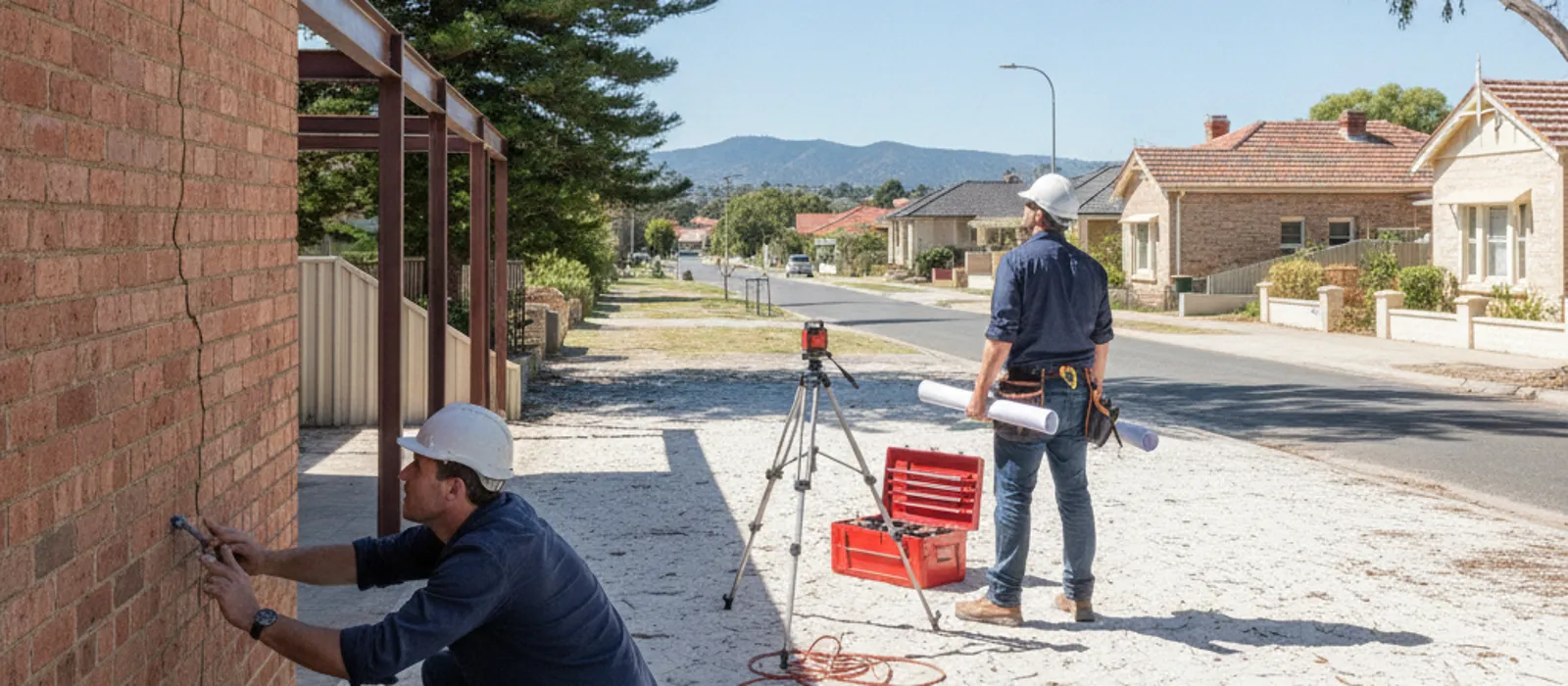
You find a stepped crack above the back window, the insurer’s website says “subsidence”, and you have a sinking feeling that the word might also describe your bank balance. Before you lodge anything, it pays to understand what subsidence actually is, why insurers treat it so warily, and what evidence tends to matter when a Perth house moves.
This guide is general information, not advice on your policy or your house. It can’t tell you whether a claim will be paid or whether a crack is harmless. What it can do is help you ask better questions, in the right order.
If you already have a crack you’re worried about, tell us what you need looked at and we’ll put you in touch with an independent structural engineer who quotes and contracts with you directly. Then read on while you wait.
What subsidence means for a Perth house
Subsidence is the downward movement of the ground under a building, which drags the footings and the walls with it. Settlement is a close cousin: a slower, usually smaller sinking as soil compacts under load. Heave is the opposite, where reactive clay swells and pushes up. In everyday talk, owners and insurers use these words loosely. In a policy document, the exact word can matter.
Perth’s ground is more varied than people assume. A Perth geotechnical firm notes that the most common soil in the metropolitan area is sand, which normally falls into AS 2870 Class A, while soft or loose sand sites are Class P and clay sites turn up “particularly in the Perth Hills”. Geoscience Australia describes the Guildford Formation, a silty and sandy clay, outcropping over much of the eastern Perth region. It also describes clayey alluvium on the Pinjarra Plain, which is relevant to the Peel area, and limestone with solution channels and cavities along the coastal strip.
None of that tells you what is under your house. No source we’ve found assigns a soil type or site class to a named suburb, so a neighbour’s clay (or lack of it) proves nothing about your block. Only site information, such as a soil classification report from the original build or a geotechnical investigation, can do that.
The structural inspections page explains what an engineer looks at on a visit and how the process works.
Subsidence versus settlement, heave and ordinary movement
Owners often ask whether their crack is “subsidence” or “just settlement”. The honest answer is that the label matters less than the cause, and the cause is what an engineer works out.
CSIRO’s guide to foundation maintenance and footing performance lists the causes that show up most often:
- Leaking pipes. A leaking water, sewer or stormwater pipe near a building can erode, swell or saturate the ground. On clay, a very small leak can be enough.
- Roof water. Downpipes not connected to a stormwater system dump water beside the footings.
- Overwatering. Misused automatic watering systems are a common cause of saturation.
- Trees. Roots can lift footings, or dry out clay so it shrinks.
- Seasonal clay movement. Reactive clay swells when wet and shrinks when dry, so the ground dishes and domes over a year. Doors bind and cornices crack.
- Erosion in sand. Sandy soil is particularly easy to wash away, and older masonry has little resistance to it.
Notice how many of those are water problems that a homeowner can influence. That is exactly why insurers scrutinise them, and it is why the why Perth houses crack guide is worth a read before you talk to anyone. If tree roots are your suspect, see tree roots cracking a house.
Three Perth situations and what each one turns on
These are anonymised, typical situations, not client stories. They show how the same word, subsidence, covers quite different problems.
A Kalamunda home whose back doors started sticking after a wet winter. The owners noticed doors binding and a hairline crack in a cornice, but nothing dramatic outside. The Perth Hills are the one area where the published geology supports reactive clay, so seasonal swelling is a plausible suspect, along with a downpipe or a leaking pipe. What it turns on: whether the movement is seasonal and reverses, or progressive. That is a question for monitoring and an engineer’s opinion, not a guess. Nothing here suggests the house is in trouble, and nothing rules it out.
A stepped crack above a window in a Rockingham house, two streets from the beach. The crack follows the mortar joints and measures about 4 mm at its widest. On the CSIRO scale below, under 5 mm is category 2 (slight). A crack that has grown to 6 mm would sit in category 3 (moderate). Coastal WA is hard on steel lintels, and a rusting lintel expands and cracks the brickwork around it, typically above windows and doors. So “subsidence” may be the wrong diagnosis entirely. If the lintel is the cause, the story for an insurer is different again. See rusted lintels in Perth for how that plays out.
A northern suburbs home in sand, with a soakwell tight against the wall. The owners noticed a vertical crack beside a door and a slightly dished patch of paving. In sand, erosion is the classic mechanism, and the City of Joondalup expects a soakwell to sit at least its own width away from buildings and boundaries so that excavation and saturation don’t undermine footings. What it turns on: where the water goes when it rains, and whether the crack has changed since it was first photographed. Which brings us to evidence.
What home insurance policies often say about subsidence and ground movement
Policy wording varies, so read your own. As an example only, one large WA insurer’s building, contents and personal valuables product disclosure statement dated 25 February 2021 (current edition not confirmed) excludes “Erosion, landslide, subsidence or movement” unless it is directly caused by an earthquake within a set window. The same document excludes defects in design, material or product and structural failure, unless the owner did not know and could not reasonably have known. It also excludes water damage from gradual leakage over time where the owner should have known of the leak.
That combination is why many Perth owners find subsidence claims difficult. Many home policies exclude gradual subsidence and ground movement. If the cause is a slow leak, that may be excluded too. We can’t tell you how your insurer will read a particular loss, and nobody at this website can.
What you can do sensibly:
- Read your product disclosure statement first. Look at the exclusions section, and at what it says about subsidence, landslip, erosion, gradual leakage and structural defects.
- Photograph and date everything. Put a ruler or a crack gauge card beside the crack in every photo, and repeat the photo at the same spot every few weeks.
- Ask your insurer in writing what the policy covers. Do this before you commission repairs, so you aren’t guessing.
- Don’t let anyone quote for repairs before you know the cause. Patching a crack that is still opening is money you may spend twice.
If your claim is declined or you’re in a dispute with a builder over defective work, Building and Energy (part of DEMIRS) handles building disputes under the Building Services (Complaint Resolution and Administration) Act 2011. Complaints about building service work are generally possible up to six years after the work was completed, and home building work contract complaints, for contracts valued between $7,500 and $500,000, generally within three years. A Notice of Proposed Complaint must be served on the other party at least 14 days before lodging. Check the current rules on the Building and Energy website before relying on those periods.
Crack width and damage categories: a rough guide, not a diagnosis
Australian Standard AS 2870 classifies damage to masonry by crack width and effect. CSIRO reproduces the table in its 2024 guide, and it stops at category 4. It’s a useful way to describe what you’re seeing to an engineer, but it can’t replace one looking at the house.
| Category | Approx. crack width | Typical damage |
|---|---|---|
| 0 Negligible | under 0.1 mm | Hairline cracks |
| 1 Very slight | under 1 mm | Fine cracks not needing repair |
| 2 Slight | under 5 mm | Noticeable, easily filled; doors and windows stick slightly |
| 3 Moderate | 5 to 15 mm, or several cracks of 3 mm or more in one group | Some wall replacement possible; doors and windows stick; pipes can fracture |
| 4 Severe | 15 to 25 mm, also depends on number of cracks | Extensive repair; frames distort; walls lean or bulge |
Source: CSIRO Building Technology File 18 (2024), reproducing AS 2870-2011.
CSIRO says most cracking in masonry walls is a cosmetic nuisance, but also says monitoring should always be treated seriously. Both things are true. Whether your crack is in the first group or the second is the thing you need someone qualified to decide. For a practical walk-through of the warning signs, see cracks in walls: when to worry and cracks in brick walls.
Who to call first, and what a report can and can’t do
There are two very different products that both get called a “structural inspection”, and mixing them up is the most expensive mistake in this area.
- A building inspection is usually a pre-purchase style report to AS 4349.1 prepared by a building inspector. Perth firms publish prices for these in the region of $440 to $550, depending on the firm, whether GST is included, and what is bundled in. That is a building-inspection price, not an engineer’s fee.
- A structural engineer’s report is an engineer’s opinion on the structure: foundations, walls, floors, roof, and the cracks in them. Perth engineers do not publish a fee for this. Engineers quote each job, and the price depends on the house, the structure and what the insurer or council needs.
For context only, the interstate and national figures below are not Perth prices, and you shouldn’t budget from them.
Interstate / national figures, not Perth prices. A national quote marketplace reported, from about 370 projects in 2026, roughly $560 per residential inspection and report (excluding GST) and an hourly rate of $150. Those figures come from across Australia and include no Perth number.
If you’re weighing the two, our comparison of a structural inspection and a building inspection sets out what each one is meant to answer. And if you want to know what an engineer produces once they’ve been on site, what does a structural engineer do covers the usual parts of a report.
A few honest limits. An engineer’s report describes the condition at the time and offers an opinion on the likely cause and what to do next. It doesn’t bind your insurer, and it can’t promise a claim will succeed. Engineers assess and design. Registered builders do the building work, and any underpinning or footing replacement is a specialist job for a suitably licensed contractor, not something this site arranges.
If footing work is recommended, expect paperwork. Under the Building Regulations 2012, underpinning or replacement of footings is not exempt from a building permit. A certified permit application costs 0.19 per cent of the estimated value of the work, but not less than $121.00, plus state levies. Decision periods are set by the regulations, but they are not a promise about how long any particular job will take.
From 1 July 2027, structural engineering work in WA must be done by a registered building engineer. If you want to confirm a person’s status, you can search the DEMIRS Building Engineer Register yourself.
A sensible order of operations
Here is an order that tends to protect both your house and your options, after the record-keeping steps above:
- Stop the water. Check downpipes, taps, irrigation, and any obvious leaks. Photograph the leak or fault before it is fixed. If you suspect a buried leak, a licensed plumber can test for it.
- Get an independent structural engineer’s opinion on cause. Ask what the report will cover, whether it includes monitoring, and how the engineer will describe the cause.
- Decide on repairs only after that. The right repair for a leaking pipe, an eroded footing and a rusting lintel are three different jobs.
If you’d like a written quote from an independent structural engineer, tell us what needs looking at or call (08) 5550 6237. Kings Park Structural Co is a referral service that is paid for referrals. We pass your enquiry to an independent structural engineering firm, which quotes you and contracts with you directly.
Frequently Asked Questions
Does home insurance cover subsidence in WA?
It depends on your policy. Many home policies exclude gradual subsidence and ground movement, and some also exclude gradual leakage and structural defects. Read the exclusions in your own product disclosure statement and ask your insurer in writing how it applies to your situation.
What is the difference between subsidence and settlement?
Both describe the ground and footings sinking. Settlement usually refers to slow compaction of soil under load, while subsidence tends to describe movement caused by something else, such as erosion, a leak or drying clay. The label matters less than the cause, which an engineer works out on site.
Is a stepped crack always subsidence?
No. Stepped cracks in brickwork can come from ground movement, but also from a rusting lintel, thermal movement or a long-running leak. The width, pattern and whether it is growing all matter, and that is what an engineer’s opinion is for.
Who can tell me the cause of the cracks in my house?
An independent structural engineer can give you an opinion on the likely cause and what to do next. A pre-purchase building inspector’s report is a different product. Engineers quote each job, so the price depends on the house and what your insurer or council needs.