
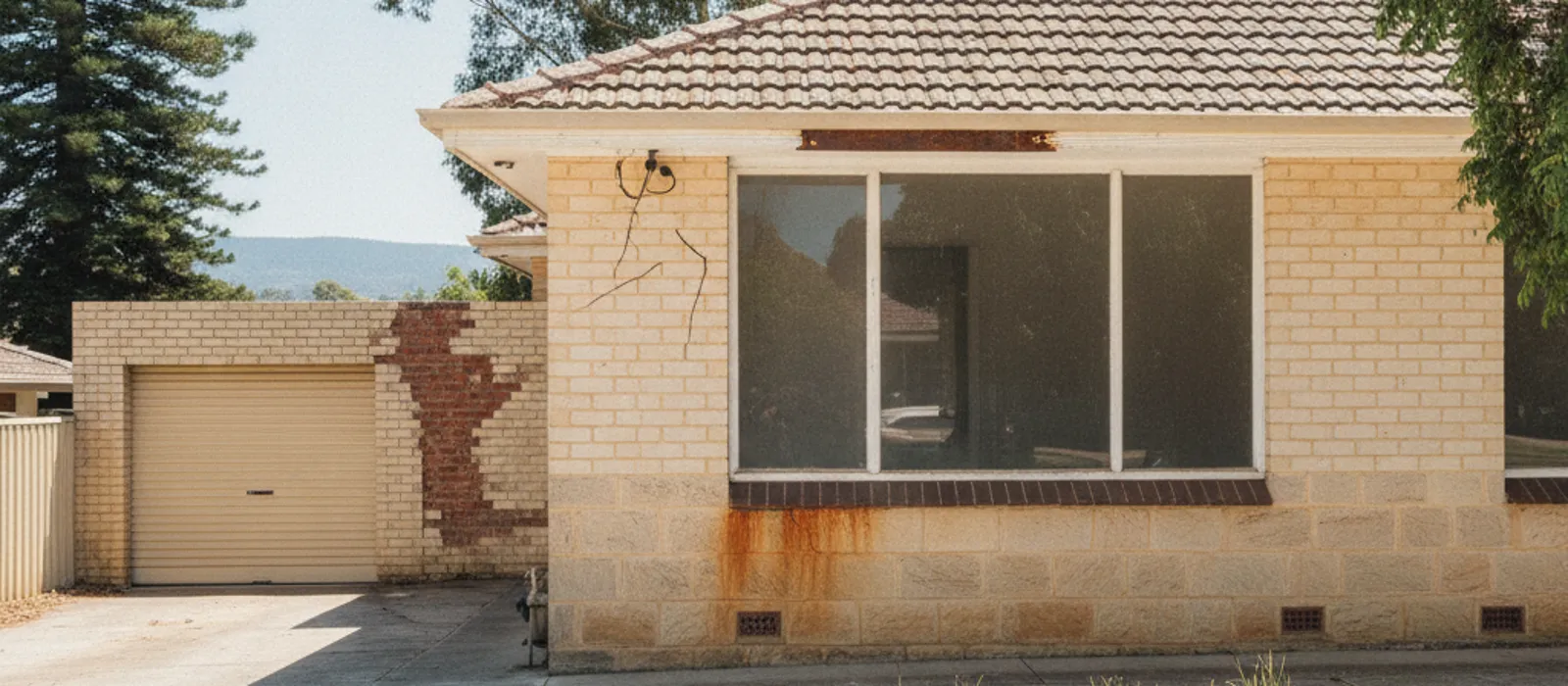
A stepped crack that starts at the corner of a window and climbs through the brickwork is easy to ignore for a year or two. Then the brick above the opening starts to sit proud of the wall, a rust stain bleeds down the render, and you are asking whether you need lintel replacement and who decides. This guide explains what a steel lintel does, why the ones in Perth brick homes can rust and crack the wall around them, and what the sensible order of steps looks like before anyone picks up a grinder.
What a lintel does, and why it rusts
A lintel is the beam that carries the brickwork over a window, a door or a garage opening. In a lot of Perth brick homes it is a length of galvanised or painted steel angle, sitting in the wall with mortar and brick around it. The steel takes the load of the masonry above and passes it to the wall on either side of the opening.
Perth has plenty of these. An HIA-commissioned report cited by ABC News in June 2026 found Western Australia is the only state where more than half of detached houses are built of brick, at 68 per cent.
Steel that stays dry stays fine. Steel that gets damp, especially with salt in the air or in the mortar, corrodes. Rust takes up considerably more volume than the steel it came from, so a corroding lintel pushes outward and upward on the brick and mortar sitting on and around it. A Western Australian building-inspection firm has described the coastal strip as close to ideal conditions for this, and says the result is cracking in the brickwork and mortar around the lintel, typically above windows and doors. That is one inspection firm’s view, not a standard, so treat it as a reason to look rather than a rule.
If you would like an independent structural engineer to look at a crack above an opening, tell us what you need looked at and we will pass your enquiry to one who quotes you directly.
Signs of a rusting steel lintel
No single sign proves a lintel is the problem. Together, they build a case.
- A horizontal crack in a mortar joint running along the underside or top of the lintel, often the full width of the opening.
- Stepped cracks rising from one or both ends of the lintel.
- Brickwork that has lifted, so the course sitting on the lintel looks slightly higher or proud of the courses beside it.
- Rust stains or flaking on the visible steel, or brown streaks running down the wall below it.
- Bulging or blown render directly above the window, where the coating has been pushed off by what is behind it.
- A gap or sag in the brickwork above the opening, or a window or door frame that has started to bind.
Take photos with a tape measure in the frame, and note the date.
Cracks above windows are not always the lintel
Here is the part that trips owners up. A crack at a window corner has more than one possible cause, and the wrong guess leads to the wrong repair.
CSIRO’s guidance on foundation maintenance and footing performance notes that masonry shows erosion or movement as step cracking through the mortar and as vertical cracks at openings, and that older masonry has little resistance to it. Openings are weak points in a wall, so they crack first no matter what is driving the movement. On a reactive clay site in the eastern suburbs or the Perth Hills, seasonal swelling and shrinkage can crack walls around openings and make doors stick. A leaking pipe, a downpipe dumping water beside the footing, or an over-watered garden bed can do the same.
So the question an engineer asks is not “is there a crack?” but “what is moving, and is it still moving?” A crack from a rusting lintel is local to that opening. A crack from footing movement usually has company: other openings cracking, doors and windows sticking elsewhere, cornices opening up. Sometimes both are present at once.
For the wider picture on why Perth houses crack, see why Perth houses crack and cracks in brick walls.
Three situations that come up
These are anonymised scenarios, not client stories. They show how the same symptom can lead to different conclusions.
A stepped crack above a window in a Rockingham house two streets from the beach. The owners measure a crack about 6 mm wide at the top corner of a kitchen window, with a rust-coloured stain running down from the lintel line. In CSIRO’s crack scale, 5 to 15 mm sits in the moderate category, which describes damage that may need parts of the wall taken out and replaced. That does not make it a lintel failure. It means an engineer should see it, check whether the lintel is corroding, and check whether the footing under that corner has moved. Salt air makes the lintel a plausible suspect, but it is a suspect, not a verdict.
A 1970s double-brick home in Duncraig with cracks above two windows and a bulge in the render. Both cracks are horizontal and run along the top of the opening. There are no sticking doors and no cracks elsewhere. That pattern points toward the lintels themselves, and the useful next step is for the engineer to have the render and a few bricks opened up so the steel can be seen. Nobody can judge how much section is left in a lintel from the outside of a rendered wall.
A Kalamunda home on clay whose back doors started sticking after a wet winter. A hairline crack has appeared above the sliding door, and the owner is convinced the lintel is rusting because a neighbour’s was. But the sticking doors and cornice cracks in two rooms suggest movement in the ground, not a single failing lintel. Replacing a lintel would not touch the cause. This is the case where spending on the wrong repair costs the most.
What lintel replacement involves
Once the cause is confirmed, lintel replacement is building work, and that is a different trade from the engineering. An independent structural engineer assesses the wall and designs the fix. A registered builder carries it out. We do not arrange or carry out either.
In general terms, replacing a lintel in a loaded brick wall means holding up the masonry above the opening with temporary support, cutting out the old steel, and fitting a new lintel that has been sized for the load and protected against corrosion. The bricks and mortar around it are then made good. What the engineer specifies depends on the span, what is sitting on top (roof load, an upper floor, or just brick), the condition of the wall either side, and whether the ends of the lintel bear properly.
Some jobs are smaller. If corrosion is early and the steel still has plenty of section, an engineer may recommend cleaning and treating the steel and repairing the surrounding masonry. Whether a lintel can be treated or must be replaced is an engineering judgement made on site, not from a photograph alone.
Removing or altering an element that supports another element falls outside the building permit exemption in the Building Regulations 2012 (Schedule 4, item 2), which is the same rule that catches wall removal. Whether your particular lintel job needs a permit is a question for your builder, your building surveyor or your local council. If you are also widening an opening or removing a wall, read wall removal and beam design.
What it costs in Perth, and what is not published
No Perth engineering firm we checked publishes a fee for an engineer’s crack assessment or a lintel design. Engineers quote each job. The price depends on the house, the structure and what the council needs. The builder’s cost to do the work is a separate quote again, and there is no published Perth figure for lintel replacement that we can stand behind, so we will not give one.
The Perth figures that do exist are for other things. Here is what they are.
| Item | What is actually published | What it is |
|---|---|---|
| Pre-purchase building inspection report | From $440 incl. GST at one Perth firm; about $495 incl. GST at another | A building inspector’s report. Not an engineer’s report |
| Engineer’s crack or lintel assessment | No Perth firm publishes a fee | Quoted per job after photos or a site visit |
| Lintel design or replacement | No Perth firm publishes a fee | Engineer’s design and builder’s work are quoted separately |
| Certified building permit, Class 1 | 0.19% of estimated value, not less than $121.00 | Government charge, only if a permit is needed |
| Uncertified building permit | 0.32% of estimated value, not less than $121.00 | Government charge, only if a permit is needed |
| Building Services Levy on a permit | $61.65 if the work is $45,000 or less | Government charge, applies with a permit |
Watch the first row in particular. Some Perth “structural inspections” are pre-purchase building inspections done by building inspectors, and at least one Perth firm says plainly that it does not provide engineering drawings or certification. That is a legitimate product, but it will not give you a lintel design. The difference is covered in structural inspection vs building inspection.
Interstate and national figures are not Perth prices. Engineers elsewhere publish fees, but they tell you nothing reliable about what a Perth engineer will charge, and we do not convert them.
Who is allowed to do what
Structural engineering in Western Australia is being brought under registration. Registration of structural building engineers began on 1 July 2024, and after a transition period ending 1 July 2027, structural building engineering work must be done by a registered building engineer. You can check the Building Engineer Register kept by DEMIRS (Building and Energy) through the building engineering registration page on wa.gov.au.
A few plain-language points:
- Ask any engineer who quotes you what their registration status and class are, and check it yourself.
- Kings Park Structural Co is a referral service. We pass your enquiry to an independent structural engineer, who quotes you and contracts with you directly. We hold no engineering registration, and we do not inspect, design or certify anything.
- Engineers assess and design. Registered builders build. If someone offers both in one package, ask who is taking responsibility for which part.
Getting the sequence right
The order matters more than the speed. A sensible sequence for a suspected rusting lintel looks like this.
- Photograph and measure. Record crack widths, rust staining and any bulging with a date. Photograph the inside of the wall below the opening too.
- Rule out the obvious water sources. A leaking downpipe, a broken pipe or a garden bed hard against the wall can do the same damage to a lintel as salt air.
- Get an independent assessment. Ask for an engineer, not only a general building report, and ask what the assessment will cover before you agree.
- Let the engineer decide whether to open up. On rendered walls, the steel often cannot be judged until a section is exposed.
- Only then get builder quotes. Give each builder the same engineer’s scope so the quotes compare like with like.
- Ask about approval early. If the work needs a permit, the timing changes.
If your crack is part of a bigger pattern in the house, cracks in walls: when to worry is a good next read, and what a structural engineer’s report contains will help you judge what you are being offered.
When you are ready, send us a short description and photos of the crack and the opening, and we will pass them to an independent structural engineer who can quote the assessment. If you prefer to talk it through, the number is (08) 5550 6237, though the form is the faster route. We cannot promise a wall is sound or a crack is harmless, and neither should anyone quoting you from a photo.
For a broader look at foundation movement and what causes it, CSIRO’s Foundation Maintenance and Footing Performance guide is a good plain-English reference.
The structural inspections page explains how an enquiry is passed on.
Frequently Asked Questions
How do I know if a crack above my window is from a rusting lintel?
You cannot be certain from the outside. Horizontal cracking along the top of the opening, lifted brickwork, rust staining and bulging render all point that way, but the same cracks can come from footing movement or leaking water. An engineer can tell you whether the steel needs to be exposed to find out.
Is lintel replacement always necessary if the steel is rusting?
No. Early surface rust on a lintel that still has plenty of steel may be treated, with the surrounding masonry repaired. Whether a lintel can be treated or must be replaced depends on how much section is left, the load above it and the condition of the wall, and that is an engineering judgement made on site.
Do I need a building permit to replace a lintel?
It depends on the work. Removing or altering an element that supports another element is outside the exemption in the Building Regulations 2012, so many lintel jobs may need a permit. Confirm with your builder, building surveyor or local council before work starts, because the answer turns on the specific job.
How much does a structural engineer charge to assess a lintel?
No Perth engineering firm we checked publishes a fee for this. Engineers quote each job, and the price depends on the house, the structure and what the council needs. Ask for a written quote that states exactly what the assessment covers before you agree.