
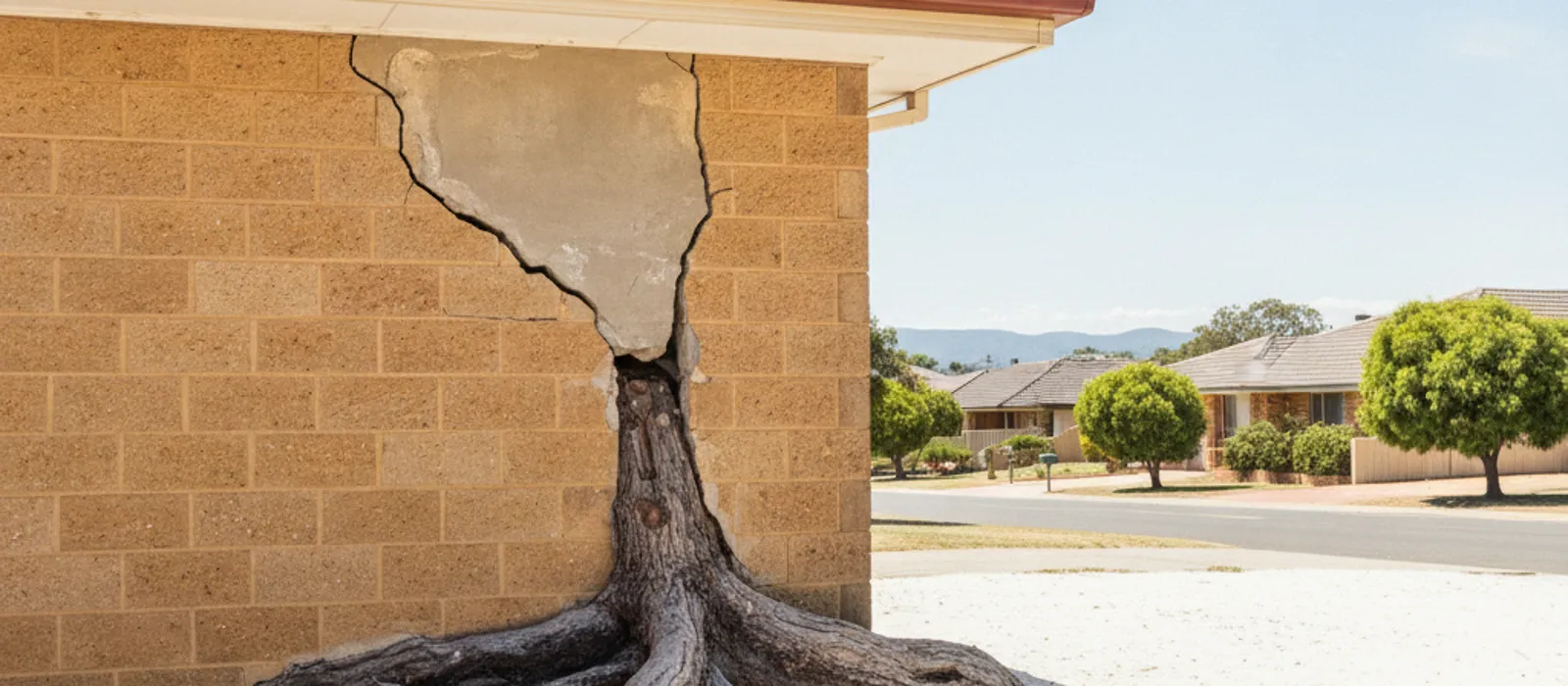
A quote from a tree lopper lands in your inbox, and the crack in the lounge room wall is still there. The lopper says the gum by the boundary has to go before it “takes the house out”. Before you pay for that, or decide the tree is innocent, it helps to know what the evidence actually supports.
Tree roots foundation damage is real, but it is not the default explanation for every crack. CSIRO’s homeowner guide to footing performance says roots can lift footings, or dry out clay soil so it shrinks. That is a short list of mechanisms, and each one needs particular conditions. This article covers when those conditions apply, when something else is the more likely culprit, and how to get an independent structural engineer to look at it properly.
If you’d rather skip the reading, tell us what you need looked at and we’ll put you in touch with an independent structural engineer who quotes you directly. The rest of this page explains what that engineer will be weighing up.
What roots can and cannot do to a footing
Start with the two mechanisms CSIRO names in Building Technology File 18, the 2024 edition of its guide to foundation maintenance and footing performance. Roots can physically lift a footing. Or they can draw moisture out of clay so the clay shrinks and the ground under the footing drops away.
Those are different problems with different signatures.
Lifting. A root growing under or against a light footing can push it up. This is a local, physical effect. It tends to show up close to the tree, on the side of the house nearest it, and it can be hard to miss if a paving slab or a section of slab edge has visibly tilted.
Shrinkage. Here the root never touches the footing. The tree takes water from reactive clay, the clay shrinks, and the footing settles into the gap. CSIRO’s wider point on clay is that seasonal swelling and shrinking causes dishing and doming of the ground, and that doors bind and cornices crack as a result. This mechanism needs clay. It is not a sand problem.
That last point matters in Perth. Geoscience Australia describes the Bassendean Sand as covering much of central Perth, with limestone and dune sands along the coast. A Perth geotechnical firm says the most common soil type in the metropolitan area is sand. On sand, the shrinking-clay mechanism has little to work with. Clay is documented in the eastern suburbs, where the Guildford Formation outcrops, in the Perth Hills, and on the Pinjarra Plain in Peel. Even there, no source we found assigns a soil class to a particular suburb or street, so your block’s soil is something to be tested, not assumed.
Why the tree gets blamed first
A tree is visible, it’s big, and it’s usually the newest thing you can point at. But CSIRO lists several other causes of footing movement, and a few of them are very common in Perth:
- Leaking pipes. A leaking water, sewer or stormwater pipe near a building can cause erosion, swelling or saturation. CSIRO says even a minuscule leak can be enough to saturate a clay foundation.
- Roof water. Downpipes that aren’t connected to a stormwater system dump water beside the footings.
- Overwatering. CSIRO calls misuse of automatic watering systems a common cause of saturation.
- Washed-out sand. CSIRO notes that sandy soil is particularly susceptible to being washed away.
Here is the awkward part. A leaking pipe and a thirsty tree can produce similar cracks, and both can be present at once. If you remove the tree and the leak keeps running, you have spent money and the wall carries on moving. If you fix the leak and the tree is the real driver, same result.
That is why a one-cause story (“it’s the roots”) deserves suspicion. The honest answer is usually a shortlist of causes and a plan to rule them in or out.
Reading the crack and the tree together
Engineers don’t diagnose from the tree alone or the crack alone. They look at the pattern of cracks against the position of the tree, the season, the ground and the building. You can gather most of what they’ll ask for before anyone visits.
Some things worth noting down:
- Where the cracks are relative to the tree. Are they clustered on the near side of the house, or spread evenly around it?
- Whether they open and close with the seasons. Cracks that widen in dry months and narrow after rain suggest moisture-driven movement. That is a pattern, not a diagnosis.
- Sticking doors and windows. CSIRO lists doors and windows that stick as a sign of movement in clay, and as damage at the moderate end of its scale.
- The plumbing and drainage. Any wet patches, unusually green lawn near the wall, or a downpipe that empties at the footing.
- The age of the tree and the house. Did the crack appear after the tree grew, after a dry summer, or after nothing obvious changed?
Photograph everything with a coin or ruler in frame, and date the photos. A crack photographed monthly for six months tells an engineer far more than one photo taken on the day they visit. CSIRO says monitoring of cracks should always be treated seriously, and dated photos are the cheapest way to do it.
For how to read patterns in brickwork specifically, see cracks in brick walls, and for the wider Perth picture see why Perth houses crack.
How serious is the crack? The CSIRO scale
Whatever is causing it, the first question is how wide the crack is. CSIRO reproduces the damage categories from AS 2870-2011, and they give you a common language with an engineer.
| Category | Approx. crack width | What it typically looks like |
|---|---|---|
| 0 Negligible | Under 0.1 mm | Hairline cracks |
| 1 Very slight | Under 1 mm | Fine cracks that don’t need repair |
| 2 Slight | Under 5 mm | Noticeable, easily filled; doors and windows stick slightly |
| 3 Moderate | 5 to 15 mm, or several cracks of 3 mm or more in a group | Some wall replacement possible; doors and windows stick; pipes can fracture |
| 4 Severe | 15 to 25 mm, depending on the number of cracks | Extensive repair; frames distort; walls lean or bulge |
Two cautions. First, the table stops at category 4, and so does CSIRO’s current guide. Don’t trust a web page that shows a category 5. Second, width alone doesn’t say why the crack is there or whether it’s still moving. CSIRO does say most cracking found in masonry walls is a cosmetic nuisance only, but that is a statement about cracking in general, not a verdict on your wall. A crack near a large tree that has widened over two summers is a reason for an engineer to look, whatever the category.
If you want a plain-language version of when to worry, read cracks in walls: when to worry.
Three situations, and what each one calls for
These are illustrations of how the reasoning goes, not case files. The details are composites.
A Kalamunda home in the Perth Hills, back doors sticking after a wet winter. Clay sites are documented in the Perth Hills, and sticking doors are a classic sign of clay moving with moisture. There is a large gum near the back verandah. The tempting story is “roots”. But a wet winter points at saturation as much as drying, so the engineer would also check downpipes, the reticulation and the pipe runs before pointing at the tree. The useful first step here is an assessment, not a chainsaw.
A stepped crack above a window in a Rockingham house, with a street tree nearby. CSIRO describes step cracking in mortar and vertical cracks at openings as signs of erosion in masonry, and notes older masonry has little resistance. Where a block sits on sand, the shrinking-clay mechanism is a poor fit, and the soil has to be confirmed rather than guessed. A leak or washed-out sand is at least as likely as roots, and rusting lintels are another suspect near the coast. The engineer’s job is to keep all of those on the list.
A 1970s double-brick home in Duncraig with a crack running up from a corner window, and a mature tree two metres from the wall. The owners are also thinking about removing an internal wall for an open-plan kitchen. Both questions go to the same person. An engineer looking at the cracking will be looking at walls and footings anyway, and can say whether the movement affects the wall-removal plan. Nobody should assume a wall is safe to remove while there is unexplained movement in the house. See how to tell if a wall is load-bearing for what that question involves.
Should you remove the tree?
Not until you know it’s the cause. Removing a tree is irreversible, and it doesn’t undo damage that has already happened. Check with your local council before removing a large tree, because rules vary and we can’t cover them all here.
There’s also a practical trap. If the tree is a contributing cause and you take it out but ignore a leaking pipe, you’ll have no way of telling which one was doing the damage. Ask the engineer for a view on the tree as part of their assessment, and get it in writing.
What we can say from the sources is limited. CSIRO says roots can lift footings or dry clay. It doesn’t give a safe distance between a tree and a house, and we haven’t found a Perth source that does. Anyone offering a firm “keep trees this far away” number should be able to show where it comes from.
What it costs to find out about tree roots and footings
Here the market is quiet. No Perth engineering firm we checked publishes a fee for an engineer’s crack report, and hourly rates aren’t published either. Engineers quote each job, and the price depends on the house, the structure and what you need in writing. Our structural engineer cost page explains what tends to move a quote.
The Perth dollar figures that do exist are for pre-purchase building inspections, which are a different product from an engineer’s report. One inspection business says its reports start from $440 including GST, and another says an average Perth home costs about $495 including GST. Those are inspections by building inspectors, not a structural engineer’s assessment of why your wall is moving. Don’t treat them as a price for the job in this article.
If a lopper or a landscaper is telling you the tree must go, get an independent view first. Our page on structural inspections covers what a report usually contains, and structural engineer reports explains how to read one.
Insurance and next steps
Many home policies exclude gradual subsidence and ground movement. One large WA insurer’s product disclosure statement, dated 2021, lists erosion, subsidence and movement as a general exclusion with a narrow exception, and also excludes gradual leakage over time where the owner should have known about the leak. Policies differ and that document may not be current, so check your own policy’s exclusions before you assume anything. Our guide on subsidence and insurance in WA has more.
A sensible order of operations if a tree and a crack are both worrying you:
- Photograph and date the crack, with a scale in frame.
- Check downpipes, taps, reticulation and any wet patches near the wall.
- Note the tree’s distance from the house and which side it stands on.
- Get an independent structural engineer’s view before any tree or pipe work.
- If you’re also planning building work, ask about that in the same visit.
We’re a referral service. We pass your enquiry to an independent structural engineer, who quotes you and contracts with you directly. We aren’t engineers, and we don’t inspect, design or certify anything. From 1 July 2027, structural engineering work in WA must be done by a registered building engineer, and you can check the register through DEMIRS building engineering registration. For the technical background used in this article, see the CSIRO guide to foundation maintenance and footing performance.
Ready for a written quote? Use the enquiry form first, or call (08) 5550 6237 if you’d rather talk it through. Tell us where the cracks are and where the tree stands.
Frequently Asked Questions
Can tree roots crack a house foundation?
Yes, in some situations. CSIRO says roots can lift footings or dry out clay so it shrinks. Whether either is happening at your house depends on the soil, the tree and the building, which is why an engineer looks at all three.
How close is too close for a tree to a house?
We can’t give you a distance, and we haven’t found a Perth source that does. CSIRO doesn’t set one. What matters is your soil, the tree’s size and species, and the footing type, so ask an engineer rather than relying on a rule of thumb.
Will removing the tree stop the cracks?
Not necessarily. If a leak, roof water or eroded sand is a cause, the cracks can continue after the tree is gone. Get an independent assessment before removal, and check your council’s rules for large trees.
Will my insurance cover tree root damage?
We can’t say. Many home policies exclude gradual subsidence and ground movement, and some exclude gradual leakage. Read your policy’s exclusions, and ask your insurer directly how it treats your situation.