
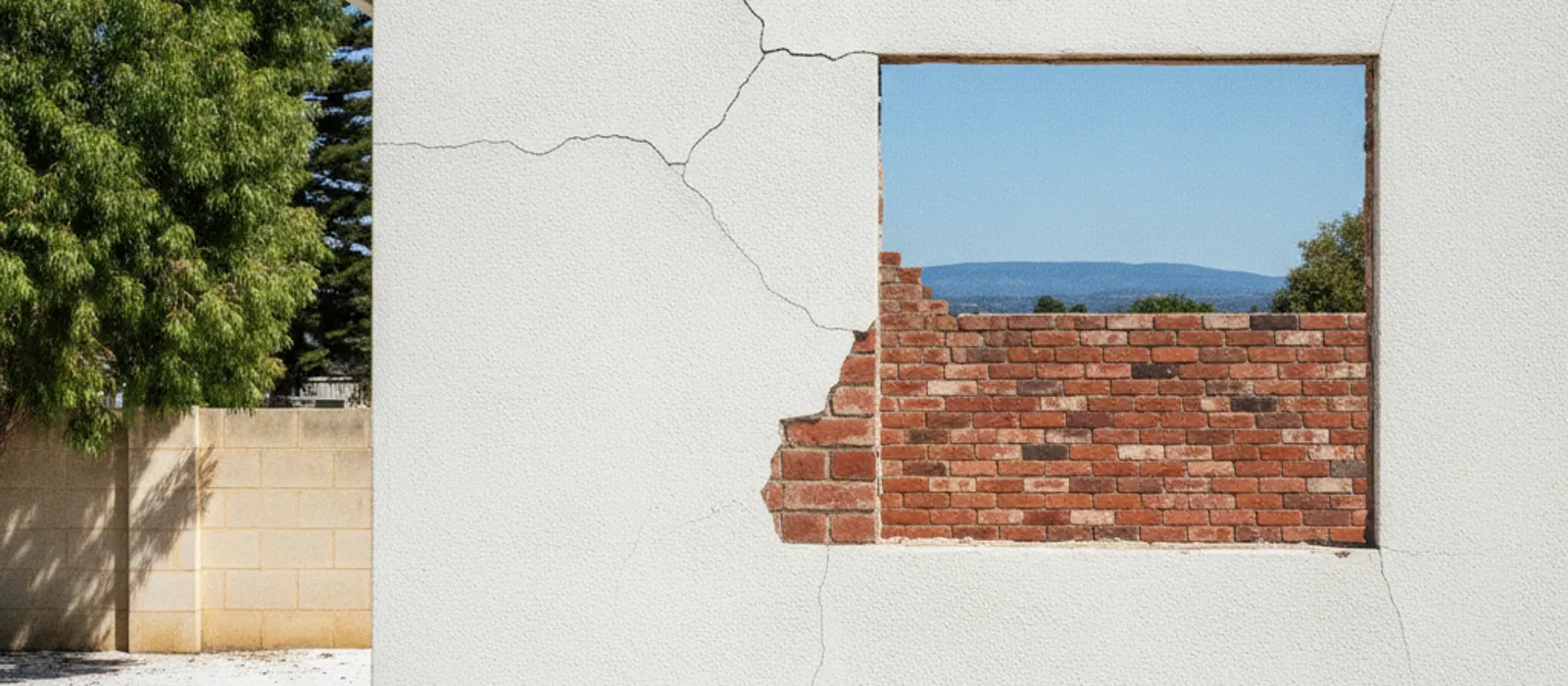
A line has opened up along the cornice in the lounge room, and this morning you noticed it runs a little further than it did last week. Now you’re wondering whether it’s a ten-minute job with a tube of filler or the first sign of a very expensive problem.
Cracks in plaster walls are one of the most common worries Perth owners have, and the honest answer is that most of them are minor. Some are not. The hard part is telling which is which from a photo, and this guide sets out how to sort them so you know what to watch and when to ask for an expert opinion.
It won’t tell you your crack is harmless. Nobody can honestly do that from a web page, and we’d be wary of anyone who does.
If you’d rather skip ahead, you can tell us what you need looked at and we’ll put you in touch with an independent structural engineer, who quotes and contracts with you directly. We’re a referral service, not an engineering firm, and we’re paid for the referrals we make.
What cracks in plaster walls can and can’t tell you
Plaster is a hard, brittle skin. It has almost no give, so it shows movement in the structure behind it long before anything else does. CSIRO’s homeowner guide to foundation maintenance (Building Technology File 18, 2024 edition) makes two points worth holding in your head together. It says most of the cracking found in masonry walls is a cosmetic nuisance only. It also says that monitoring cracks should always be treated seriously. Both are true. The trick is working out which side of that line your crack sits on.
A crack in plaster can come from several places:
- The plaster itself. Drying, seasonal temperature and humidity swings, and joints between sheets or between wall and ceiling can all open thin lines with no structural cause.
- Movement in the ground. Reactive clay swells and shrinks, sand can wash out from under a footing, and tree roots can dry clay or lift a footing. The wall follows the footing, and the plaster cracks.
- Water. CSIRO points out that even a small leak from a water, sewer or stormwater pipe can saturate the ground, and that overwatering from automatic systems is a common cause.
- Load and openings. A lintel that is corroding, a beam that is under-sized, or a wall that has been altered can all show up as cracking at doors, windows and ceilings.
The plaster can’t tell you which of these you have. The pattern, the width and whether it changes over time can help.
Cornice cracks and the patterns worth sorting first
Start by describing the crack rather than guessing its cause. Where is it, which way does it run, and is it the same width along its length?
A hairline crack along the cornice or at a ceiling joint. This is the most common one. CSIRO notes that on reactive clay, seasonal swelling and shrinking make doors bind and cornices crack. A fine line that comes and goes with the seasons is often nothing more than that, but a line that keeps widening deserves a second look.
Straight hairline cracks along sheet joints. These follow the tape lines where plasterboard sheets meet. They are often a finishing or drying matter, though a joint that gapes on one side is a different story.
Diagonal cracks from the corners of doors and windows. These are worth attention. Openings concentrate stress, and a crack radiating at 45 degrees from a corner can mean the wall is shifting around the opening.
A crack that carries through from the brickwork outside. If the same crack shows on both faces of the wall, or you can trace a stepped line in the mortar outside, treat it as a wall crack rather than a plaster one. Our guide to cracks in brick walls covers how to read those.
Ceiling cracks. A crack along a ceiling and a sagging ceiling are not the same thing, and the sag is the one to take seriously. See cracks in ceilings for the detail.
Cracks with a step or offset. Run a fingertip across the crack. If one side sits proud of the other, the two faces have moved relative to each other, and that is more significant than a clean line.
Crack widths: the CSIRO damage categories
Engineers grade damage using crack width and the effect on the building. CSIRO reproduces the categories from the Australian Standard for residential slabs and footings (AS 2870-2011), and they are a useful yardstick at home with a ruler or a crack gauge. The table below paraphrases them.
| Category | Approx. crack width | Typical damage |
|---|---|---|
| 0 Negligible | Under 0.1 mm | Hairline cracks |
| 1 Very slight | Under 1 mm | Fine cracks that don’t need repair |
| 2 Slight | Under 5 mm | Noticeable but easily filled; doors and windows may stick slightly |
| 3 Moderate | 5 to 15 mm, or several cracks of 3 mm or more in one group | Some wall replacement may be needed; doors and windows stick; pipes can fracture |
| 4 Severe | 15 to 25 mm, also depends on the number of cracks | Extensive repair; frames distort; walls lean or bulge |
Width is only one input: the number of cracks, whether they are growing, and where they sit all matter. The categories also describe damage that has already happened. They don’t tell you the cause, or whether it has stopped.
Three field scenarios (anonymised)
These are composites of the kinds of enquiries a Perth engineer might see, not case studies of real jobs. The outcome on your own house will depend on the site.
A stepped crack above a window in a Rockingham house. The owners painted over a hairline crack above the lounge window last year. It came back through the paint, and now it’s about 2 mm wide at the top and runs diagonally in the plaster towards the next window along. On the outside the mortar shows a matching stepped line. On the CSIRO scale that width sits in category 2, but the crack has been growing and is present on both faces of the wall, which is why a photo series and a look at the lintel and the ground around the footing make sense. A rusting steel lintel can also crack the brickwork and mortar around it, typically above windows and doors. The sensible next step is a report from an engineer, not more filler.
A Perth Hills home where the back doors started sticking after a wet winter. The owners noticed the sliding door catching in the frame and a cornice crack in the family room. Geoscience Australia describes the Guildford Formation, a silty clay, outcropping over much of the eastern Perth region, and a Perth geotechnical firm says clay sites turn up particularly in the Perth Hills. If the block does sit on reactive clay, seasonal swelling and shrinking is one plausible cause, and so is a downpipe discharging next to the footing. This is where an engineer will want to see photos, the drainage layout and the garden watering pattern before offering any view. Nobody should guess from the cornice alone.
A double-brick house in Duncraig where the owners want the kitchen wall gone. They’ve spotted a hairline crack in the plaster above that same wall and wonder if it matters. It might not, but it does change the conversation. In a full-masonry house, CSIRO says the inner leaf of the external walls and at least some internal walls usually carry upper floors, ceilings and roof. In WA, removing or altering a load-bearing element is not exempt from a building permit. Before anyone plans a beam, the wall needs to be assessed by an engineer. Our page on wall removal engineering explains that path, and the guide to load-bearing walls in double-brick homes covers the background.
What to do this week if you find a crack
You don’t need special equipment to build a useful record. An engineer will ask for the same information, so gather it now.
- Photograph it with a scale. Put a ruler or a coin beside the crack, and take one wide shot and one close-up. Add the date to the file name.
- Mark and measure. Draw a pencil line across the end of the crack and write the date next to it. Measure the width at its widest point every couple of weeks.3. Check for water. Look at downpipes, taps, hot water overflow pipes and the reticulation near the wall. CSIRO lists leaking pipes, roof water discharged next to footings and overwatering as common causes of ground movement.
- Note trees, doors and windows. Write down large trees near the wall, and which doors or windows stick and since when.
- Check your policy. Many home insurance policies exclude gradual subsidence and ground movement, and some exclude gradual leakage. Read your own policy’s exclusions before you assume anything is covered, and speak to your insurer before repairs if you plan to claim.
Resist the urge to fill and repaint straight away. Fresh filler hides the evidence of how the crack is moving. If the crack is growing, fixing the plaster does nothing about the cause.
When to get an independent structural engineer to look
Not every crack needs an engineer. A hairline along a cornice that hasn’t changed in a year is probably a job for a painter. Consider getting a professional opinion when:
- a crack is wider than about 5 mm, or you can fit a coin edge into it;
- cracks are growing, or new ones keep appearing;
- doors and windows are sticking at the same time;
- a crack shows on both sides of a wall, or has a step in it;
- you’re planning to buy the house, extend it or remove a wall;
- you’re in a dispute with a builder or an insurer.
Be clear about what you’re buying, too. Plenty of “structural inspections” on the Perth market are pre-purchase building inspection reports written by building inspectors. Reports of that kind are advertised in Perth from around $440 including GST, and that’s a building inspection product, not an engineer’s report. Our guide to structural inspections versus building inspections explains the difference in more detail.
What does an engineer’s crack report cost? No Perth engineering firm publishes a fee for one, so we won’t invent a figure. Engineers quote each job, and the price depends on the house, the structure and what you need written down. If a rough national number helps, here it is with its label attached.
| Interstate / national figures, not Perth prices | |
|---|---|
| Australia-wide, standard residential inspection and report (national marketplace, 2026, about 370 projects) | $560 excl. GST |
| Perth, engineer’s crack report | No price published |
Treat that as background only. Your quote will come from the engineer who has looked at your photos and your house.
WA law is also changing. From 1 July 2027, structural engineering work must be done by a registered building engineer, and DEMIRS (Building and Energy) keeps a Building Engineer Register you can check through the WA Government’s building engineering registration guide. Until then, “engineer” and “structural engineer” are not reserved titles, so ask any firm about its registration status and check it yourself.
When you’re ready, send us your photos and a few lines about what you’ve noticed. We’ll pass them to an independent structural engineer, who will quote you directly. If you’d rather talk, you can also call (08) 5550 6237, though the form is the faster route. To see what a report normally covers first, read our guide to the structural engineer report and the structural inspections page.
Cracks in plaster walls and the bigger picture
Perth’s ground varies a lot across the metropolitan area, which is why we don’t assign a soil type to a suburb: your block has to be assessed on its own.
CSIRO’s guide makes the same point about diagnosis. Symptoms often don’t simply reflect the original cause, which is why a crack in the plaster needs someone to look at the wall, the footing and the ground together. For more on why houses here move in the first place, see why Perth houses crack, and for the wider picture on wall cracks, cracks in walls: when to worry. The full CSIRO document is available as a PDF from CSIRO.
Frequently Asked Questions
Are hairline cracks in plaster walls normal?
Fine cracks under 1 mm are common, and CSIRO’s categories treat them as negligible or very slight. They can still be worth photographing and dating, because a hairline that lengthens or widens over a few months tells a different story. If it stays the same, it’s often a cosmetic matter.
Can I just fill and paint a crack in a cornice?
You can, but do it after you’ve recorded the crack. Fresh filler hides how the crack is moving, and if the cause is water or ground movement it may well reopen. If you plan an insurance claim, speak to your insurer before repairs begin.
When are cracks in plaster walls a sign of a structural problem?
Wider cracks, growing cracks, stepped or diagonal cracks near openings, and cracks that come with sticking doors and windows are the ones to watch. CSIRO’s category 3 starts at about 5 mm. Only an engineer who has seen your house can say what a particular crack means.
Who should look at a cracked wall in Perth?
For a question about structural cause and safety, an independent structural engineer is the right person, and a building inspector’s report is a different product. We’re a referral service: we pass your enquiry to an independent firm, which quotes and contracts with you directly.